Appliance repair
Enable Loans Q&A: How Long Do Water Heaters Last?
Tank water heaters often last 8 to 12 years and tankless units 15 to 20. Learn the warning signs, what replacement costs, and when enable loans options make sense.
On this page
Water Heater Lifespan at a Glance
A conventional gas tank water heater typically lasts about 8 to 12 years, an electric tank about 10 to 15 years, and a tankless unit roughly 15 to 20 years or more with regular descaling.
Those ranges assume average water quality and basic care. Hard water, a high thermostat setting, heavy daily demand and skipped maintenance can take years off any unit. A water heater installed in a hot attic or an unconditioned garage also works harder than one in a basement. If you are reading this because your tank just started acting up, the age on the label is the first clue to whether a repair or a replacement is ahead, and whether you might need to look at personal loans at all.
| Type | Typical lifespan | Main thing that ends its life |
|---|---|---|
| Gas tank (storage) | 8 to 12 years | Tank corrosion and leaks |
| Electric tank (storage) | 10 to 15 years | Tank corrosion; elements can be replaced |
| Tankless (gas or electric) | 15 to 20+ years | Scale buildup in the heat exchanger |
| Heat pump water heater | About 10 to 15 years | Tank corrosion or compressor failure |
| Indirect tank (boiler-fed) | About 10 to 20 years | Tank or coil failure |
People who search for enable loans about a water heater are usually facing one of two moments: a leak that forced a decision overnight, or an aging tank they want to replace before it fails. This guide covers both, and the second is far cheaper whether you pay cash or compare enable loans offers.
Tank vs Tankless: Why Lifespans Differ
Tank heaters store 30 to 80 gallons of hot water in a steel tank that slowly corrodes from the inside. Tankless units heat water only on demand, so no tank sits full of water for years, and most of their parts can be replaced.
Every steel tank has a sacrificial anode rod, a metal rod that corrodes in place of the tank lining. Once the rod is used up, often in four to six years in hard-water areas, the water begins attacking the tank itself. When a tank rusts through, it cannot be repaired. That single failure point is why storage heaters have shorter lives, and why so many homeowners end up comparing personal loans for a tank replacement rather than a repair.
Tankless heaters have no tank to rust, but minerals in hard water build up as scale inside the heat exchanger. Flushing the unit with a descaling solution once a year, or more often with very hard water, keeps it efficient. Sensors, igniters, fans and flow switches can be swapped as they wear out, which is how many tankless units pass the 20-year mark. The higher upfront price is a big reason people research enable loans before choosing tankless.
- Tank pros: lower upfront cost and a smaller amount to cover with savings or personal loans, simple installation, works with existing venting in most homes.
- Tank cons: standby heat loss, shorter life, a leak can damage floors and belongings.
- Tankless pros: longer life, endless hot water at a set flow rate, smaller footprint, lower energy use for many households.
- Tankless cons: higher upfront cost, may need new gas line, venting or electrical work, and output can fall short when several fixtures run at once.
Warning Signs Your Water Heater Is Near the End
Rusty hot water, water pooling at the base, popping or rumbling noises, hot water that runs out quickly and a unit past its typical lifespan are the clearest signs that a water heater is failing or close to it.
| Symptom | Likely cause | Repair or replace? |
|---|---|---|
| Water pooling around the base | Tank leak, or a loose valve or fitting | Replace if the tank itself leaks; fittings are repairable |
| Rusty or brown hot water only | Corroding tank or spent anode rod | Anode replacement may help a younger tank; replace an older one |
| Popping or rumbling sounds | Sediment layer at the bottom of the tank | Flush first; persistent noise on an old tank means replace soon |
| Hot water runs out fast | Sediment, a failed dip tube or a bad heating element | Often repairable for $150 to $400 |
| No hot water at all (gas) | Pilot, thermocouple or gas valve | Usually repairable |
| Error code on a tankless unit | Scale, igniter, sensor or flow issue | Usually repairable |
| Moisture on the top or water at the relief valve | Pressure or temperature problem | Call a plumber promptly; a safety issue |
A leak from the tank body is the one sign that should end the repair-or-replace debate. For anyone who later weighs personal loans against insurance, the first step is the same: shut off the water supply valve above the heater, turn off the gas or the breaker, and call a plumber. A 50-gallon tank that gives way can flood a basement, and water damage often costs far more than the heater. Call your homeowners insurer as well; personal loans can cover the heater, but the policy may cover the resulting damage.
The serial number on the rating plate usually encodes the manufacture date. Many brands use a letter for the month and two digits for the year, but formats vary, so check the manufacturer's site or call their support line with the serial number.
What Water Heater Replacement Typically Costs
For readers comparing enable loans amounts, a standard installed 40- to 50-gallon tank water heater typically costs about $1,200 to $2,500, a tankless unit about $2,500 to $5,000, and a heat pump model about $2,500 to $4,500 before any rebates.
| Replacement | Typical installed cost | Common add-ons |
|---|---|---|
| Electric tank, 40 to 50 gallons | $1,000 to $2,000 | New breaker or wiring, drain pan |
| Gas tank, 40 to 50 gallons | $1,200 to $2,500 | Vent connector, gas flex line, expansion tank |
| Tank to tank, larger 75 to 80 gallons | $2,000 to $3,500 | Upgraded venting, stand or platform |
| Tankless, gas | $2,500 to $5,000 | New venting, larger gas line, condensate drain |
| Tankless, electric | $1,500 to $3,500 | Electrical panel upgrade can add $1,500 or more |
| Heat pump water heater | $2,500 to $4,500 | Condensate line, space and airflow needs |
When budgeting for personal loans or savings, remember that permits, haul-away of the old tank and code updates such as an expansion tank or seismic straps commonly add $100 to $500. Emergency or weekend calls can carry a premium of $100 to $300, one more reason to replace before failure rather than lean on personal loans in a hurry. Ask for a written quote that lists the unit, labor, permit, parts and disposal separately so you can compare plumbers fairly. That total is also the number to use if you plan to request personal loans, since lenders offer a single lump sum.
Federal tax credits and utility rebates have been available for qualifying heat pump water heaters, and some utilities offer rebates on high-efficiency gas units too. Program terms change, so check your utility's site and the current ENERGY STAR rebate finder before you buy. A rebate paid after installation can also be used to pay down personal loans early, if the lender does not charge a prepayment penalty.
Repair or Replace: How Age Changes the Answer
Repair a water heater that is less than about two-thirds through its expected life when the fix is a replaceable part. Replace a tank that leaks, or any unit near the end of its range facing a repair over a few hundred dollars.
Common repairs cost far less than a replacement and rarely call for personal loans: a thermocouple or igniter often runs $150 to $300 installed, an electric heating element $200 to $350, a gas control valve $300 to $600, and a tankless descaling service $150 to $300. On a five-year-old electric tank, a $250 element repair is an easy call. On an 11-year-old gas tank, a $500 gas valve may buy only a year or two before the tank itself fails, and financing that repair with personal loans means paying interest on a part that may outlive the tank it sits on.
The same thinking about age and repair cost applies across appliances. Our breakdown of whether it is worth fixing an old dishwasher uses the 50% rule with real-world quotes, and the logic carries over well to water heaters.
Replacing a heater on your own schedule, before it fails, lets you compare quotes, choose the right size and decide calmly how to pay. If you expect to cover the cost with personal loans, planning ahead gives you time to compare offers instead of accepting the first one during a flooded-basement emergency. Enable loans reviews from homeowners frequently make the same point.
Maintenance That Adds Years to a Water Heater
Cheaper than any of the personal loans in the table below, flushing a tank once a year, checking the anode rod every three to four years, setting the thermostat near 120°F and testing the relief valve annually can add several years to a water heater's life.
Flush the sediment
Turn off power or set gas to pilot, attach a hose to the drain valve and run water until it comes out clear. Sediment insulates the bottom of a gas tank and makes it overheat.
Inspect the anode rod
A rod worn down to the core wire, or coated heavily in calcium, should be replaced. A new rod typically costs $20 to $60 as a part, or $150 to $300 with a plumber.
Test the relief valve
Lift the lever briefly to confirm water flows out and stops. A valve that drips or will not open needs replacement.
Set the temperature
Around 120°F reduces scalding risk, slows corrosion and lowers energy use for most households.
Descale a tankless unit
Run a vinegar or descaling solution through the service valves once a year, or follow the manufacturer's schedule.
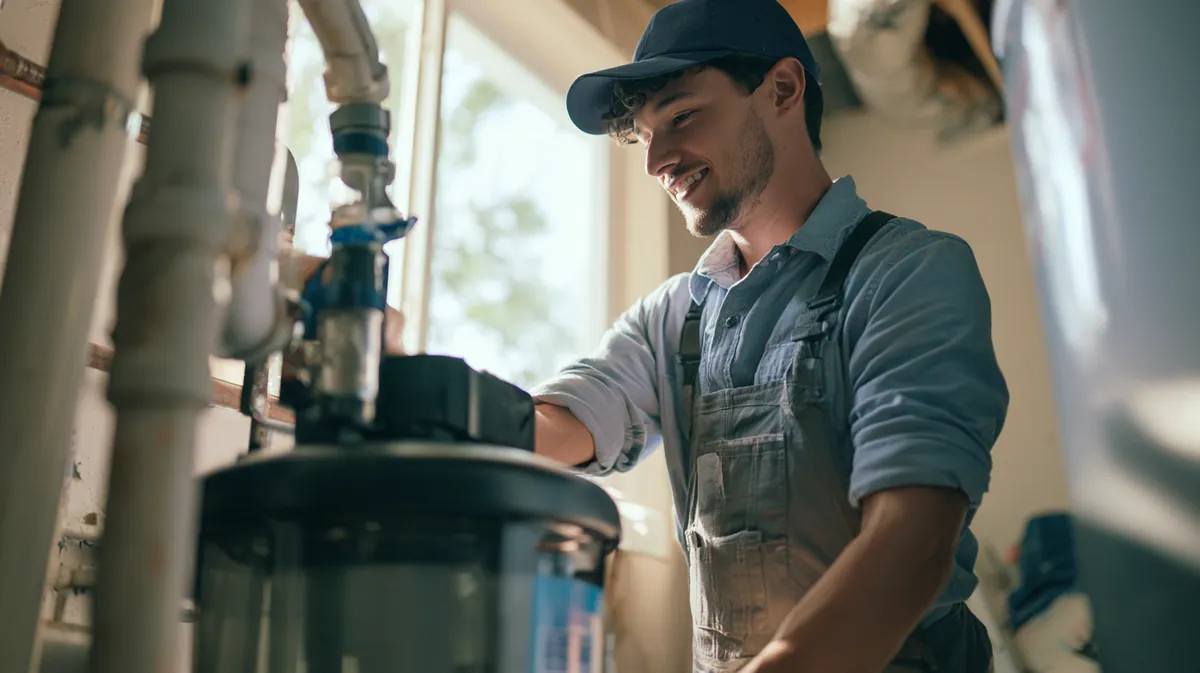
A water softener, like the one in the photo above and a frequent add-on in personal loans for plumbing work, reduces scale and can extend the life of both tank and tankless heaters in hard-water areas. It is an upfront cost of its own, typically about $1,000 to $3,000 installed, so weigh it against how hard your water actually is. Some homeowners bundle a softener and heater into one amount when comparing personal loans.
Paying for a New Water Heater With Enable Loans Offers
Savings, utility rebates, plumber financing and fixed-term personal loans are the common ways to pay, and enable loans comparisons fit into the last group. Personal loans often fit tank and tankless replacements well because most installed costs fall between $1,000 and $5,000.
Many plumbers partner with a financing company, and some advertise low promotional rates. Read the terms carefully: a 0% offer with deferred interest can charge interest back to day one if the balance is not cleared in time. Personal loans, by contrast, carry a fixed APR and a set number of payments, so you know the payoff date from the start. Most personal loans also let you pay early. Our page on appliance repair loans compares these choices across household appliances, from refrigerators to HVAC units.
| Project | Amount | Term | Monthly payment | Total interest |
|---|---|---|---|---|
| Electric tank replacement | $1,500 | 12 months | $140.02 | $180.24 |
| Gas tank replacement | $2,000 | 18 months | $130.96 | $357.28 |
| Larger gas tank or simple tankless | $3,000 | 24 months | $154.88 | $717.12 |
| Tankless with venting and gas line work | $5,000 | 36 months | $189.64 | $1,827.04 |
These payment figures use a 21.49% example APR and are estimates only. Typical APRs for personal loans of this size run about 6% to 35.99%, depending on the lender, your credit, income, state and term. The $3,000 loan page shows more term options for a mid-range replacement, and our guide to personal loan APR ranges explains what moves a rate up or down.
Comparing enable loans offers starts with one free request form on the enable loans website. The enable loans application asks for the amount, income, employment and housing details, and lenders in our network may respond with offers from $500 to $5,000. You review the APR, fees and term on each lender's disclosure and can decline every offer at no cost. Funding timing depends on the lender, and some fund as soon as the next business day after approval.
Borrowers often mention that requesting the full installed amount, including permit and haul-away, saved a second round of borrowing. The enable loans application takes about five minutes on the enable loans website, and the eligibility page explains what lenders typically check before an offer on personal loans.
Planning Ahead for Your Next Water Heater
Once a water heater passes the midpoint of its expected life, set aside a small monthly amount toward its replacement. About $15 to $25 a month over five years covers much of a standard tank replacement.
Write the install date on the tank with a marker, whether the heater was paid for with cash or personal loans, and add a reminder to your phone for the annual flush. When the unit reaches about 80% of its expected life, get one or two quotes so you know the price before you need it. That is also a good moment to check enable loans options without any pressure. If those quotes run higher than your savings, you can compare personal loans while the old heater still works, rather than in a rush.
- Year 1 to 4: annual flush, relief valve test, note the install date.
- Year 4 to 6: inspect or replace the anode rod; start a small replacement fund.
- Year 7 to 9: watch for rust, noise and slower recovery; get replacement quotes.
- Year 10+ (tank): plan replacement on your terms; install a drain pan and leak sensor in the meantime.
A $20 water leak sensor near the base of an older tank is cheap insurance. Enable loans reviews from people who replaced a heater after a flood often say they wish they had installed one sooner. People who track enable loans options for home appliances often find that a planned replacement costs several hundred dollars less than an emergency one, and it is easier to compare personal loans, rebates and quotes when nothing is leaking.
FAQ
Questions about this page
Does a tankless water heater really last twice as long as a tank?
Often close to it. Tankless units commonly reach 15 to 20 years or more because they have no tank to corrode and most parts can be replaced. They need annual descaling in hard-water areas to reach that range, and they cost more to install upfront.
Is it worth replacing the anode rod in a 10-year-old water heater?
Usually not. By 10 years, a rod that was never replaced has often been spent for a while, and the tank lining may already be corroding. Anode replacement makes the most sense in years four to six, while the tank is still sound.
Can a personal loan cover a water heater, permit and haul-away together?
Yes. Personal loans can generally be used for the unit, installation, permit, disposal and related plumbing or electrical work in one amount. Request the full quoted total so you do not come up short; the lender sets the APR, term and approval.
Related posts

Appliance repair loans
Fix an Old Dishwasher? An Enable Loans Guide
Typical dishwasher repair costs, the 50% rule, how age and energy use change the math, and how to pay for either choice sensibly.
Read the guide
Personal loans
Paying a Personal Loan Off Early? Enable Loans
Early payoff can save hundreds in interest. See worked examples, how prepayment penalties and precomputed interest work, and what happens to your credit score afterward.
Read the guideReady when you are
Compare personal loan offers with one request
It takes about five minutes, costs nothing to use, and you never have to accept an offer.